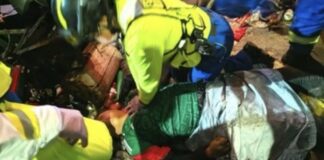
Argentine football star Diego Maradona suffered “about 12 hours of agony before he passed,” on November 25, 2020, said Carlos Casinelli, the forensic scientist who performed the autopsy on the former star’s corpse. Casinelli was the key witness in Thursday’s hearing on the trial over Maradona’s death, which also heard testimony from two of the doctors who cared for him when he was head coach at football club Gimnasia Esgrima La Plata. “He had water everywhere,” said Casinelli, adding Maradona’s face, fingers and feet were swollen. “It was a generalized edema.” The forensic expert accompanied his testimony with photographs from Maradona’s autopsy, prompting his daughter Giannina to leave the courtroom. Casinelli said he estimated the time of his passing at “between 9 a.m. and 12 p.m. on November 25.” The specialist added the health issues that led to Maradona’s death had been developing for some time, although it is “impossible to say exactly how long.” “That doesn’t develop in just one or two days. This has been going on for over a week, or even 10 days.” Casinelli said Maradona had cerebral edema, blood clots adhered to the heart walls, bilateral pleural effusion and other signs of prolonged agony. He concluded that the cause of death was “acute pulmonary edema with chronic cardiomyopathy progressing to heart failure.” Doctors After that, Flavio Tunessi, who worked as a traumatologist for Gimnasia y Esgrima La Plata, the last club Maradona worked as head coach, gave his testimony. He said that upon Maradona’s arrival at the club in September 2019, his entourage gave him the contact for Leopoldo Luque to call upon as the former star’s lead medical advisor. Luque is one of the main accused of failing to administer proper medical care to Maradona, alongside his psychiatrist, Agustina Cosachov, and psychologist, Carlos Díaz. In total, eight people stand for trial, with one, nurse Dahiana Madrid, facing a separate trial by jury at her request. He added he saw Maradona “very unwell” during the celebrations for his 60th birthday — which took place less than a month before his death — and that the former star told him “he wanted to leave.” At the request of the club’s president, Tunessi said he arranged for Maradona to be admitted to the Ipensa Clinic, where he worked, for medical evaluation. Martín Cesarini and Guillermo Burry, doctors at the clinic, were the next witnesses Cesarini, who performed the checkup, said he requested an MRI after noting “Maradona’s struggles to walk” and “fearing a blow after a fall,” but that even after spotting a subdural hematoma, “none of the evidence reviewed in the study indicated that urgent action was required.” Burry, neurosurgeon at Ipensa, concurred with Cesarini, saying the hematoma looked like it was chronic, that is, “long-standing bleeding caused by microtrauma, not from a recent fall.” “In my opinion, it wasn’t an emergency, and we needed to stabilize him first,” he said. Maradona underwent surgery to remove the subdural hematoma on November 3, and was later moved to the gated community where he passed.
Maradona death trial: autopsy showed the star suffered ‘about 12 hours of agony’
Date:

More like thisRelated
World Cup 2026: Mexico beats Ecuador 2-0, breaks ‘fifth game’ curse

The Mexican men’s national football team secured a solid...
Nightmare start for Argentine tennis at Wimbledon, nine players eliminated
It was a nightmare start for Argentine tennis at...
World Cup 2026: Paraguay shocks Germany as South America dominates
Paraguay produced one of the biggest upsets of the...
World Cup 2026: Knockout stage has begun. Who do Latin American teams face?
The 2026 World Cup has entered the knockout stage,...